Updated: 23 October 2026
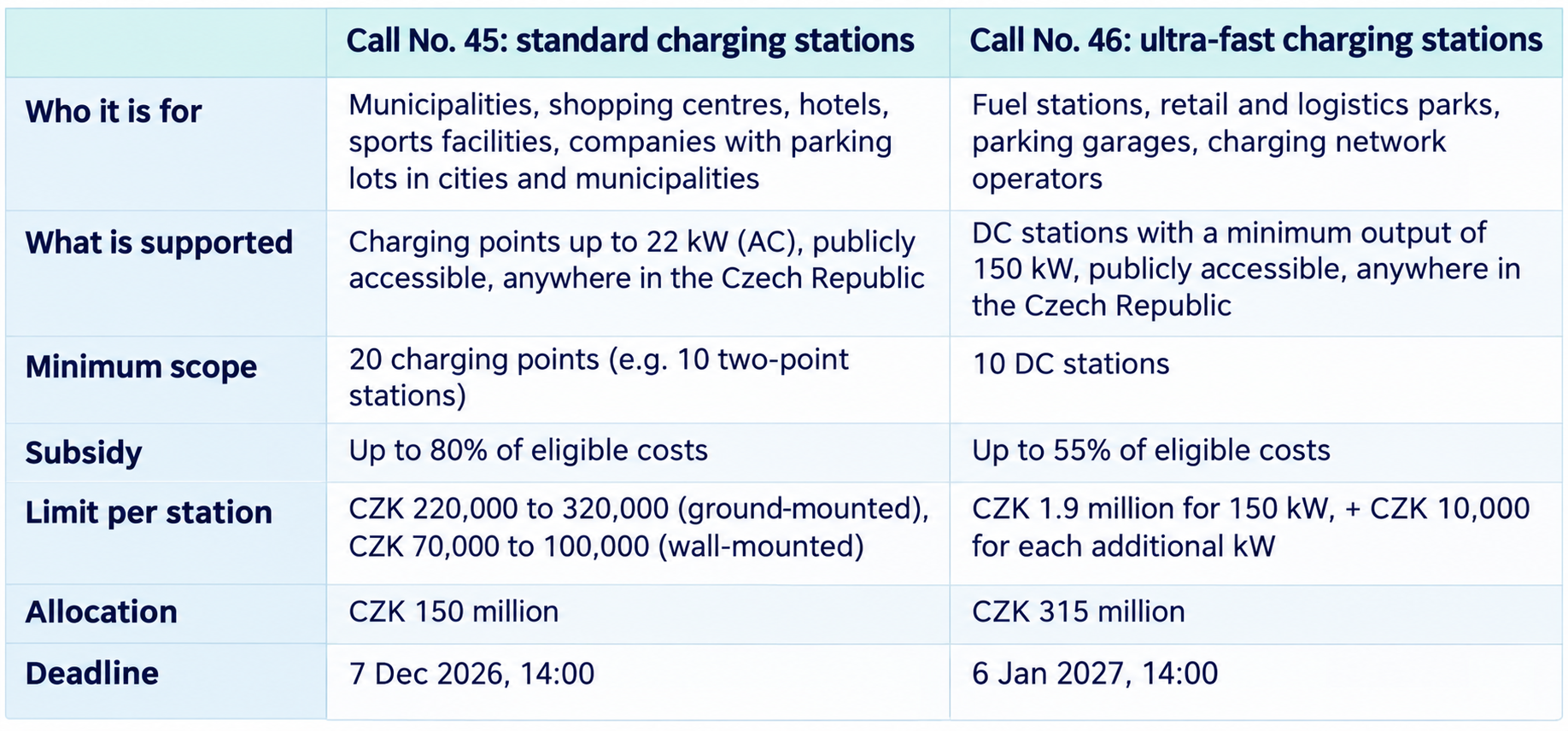
The Czech Ministry of Transport has launched two funding calls under the Transport Programme, allocating a total of CZK 465 million to public EV charging stations. Grants will cover up to 80% of eligible costs for standard AC charging stations up to 22 kW and up to 55% for ultra-fast DC charging stations of 150 kW or more. Applications must be submitted by 7 December 2026 (AC) and 6 January 2027 (DC). If you've been putting off investing in charging infrastructure due to concerns about return on investment, now is the time to reconsider the numbers.
Why now is the right time to invest in EV charging infrastructure
- High level of financial support. The subsidy covers up to 80% of eligible costs for standard charging stations and up to 55% for ultra-fast DC chargers. Eligible costs include not only the charging stations themselves, but also the grid connection, transformer station and project documentation.
- The funding window is closing. Support is provided under the EU GBER regulation, and the Ministry can issue the related legal acts only until 30 June 2027. After calls 45 and 46, the current schedule includes only one smaller call for AC charging stations (CZK 70 million, planned for December 2026) and a call focused on truck charging. Projects that miss the current opportunity may have to wait for the next programming period.
- Apply now, build by 2029. Eligible expenditure can be incurred until 30 June 2029 and the charging stations must be operational by 31 December 2029. By submitting an application now, you secure the funding while being able to schedule implementation according to grid connection and construction readiness.
What EV charging funding is currently available?
What does the subsidy mean in practice?
Standard AC charging stations
For 10 dual-socket, ground-mounted AC charging stations, the eligible expenditure limit is CZK 3.2 million.
With an 80% subsidy, public funding can cover CZK 2.56 million, while the investor contributes CZK 640,000 plus VAT from their own resources.
Ultra-fast DC charging stations
For 10 DC fast charging stations rated at 150 kW each, the eligible expenditure limit is CZK 19 million.
With a 55% subsidy, funding can reach CZK 10.45 million, while the investor contributes CZK 8.55 million plus VAT.
The eligible expenditure limit also includes the grid connection, transformer station and project documentation, meaning that at sites with straightforward grid connection requirements, the entire construction may fit within the eligible cost ceiling.
The subsidy is paid retrospectively, so the entire EV charging project must initially be financed by the applicant. The charging stations may not be sold or pledged for a period of five years after the final subsidy payment.
What requirements must an EV charging project meet?
- Public accessibility. The charging stations must be accessible to anyone, 24 hours a day. A car park behind a barrier that is available only to employees or tenants does not meet this condition.
- Payment and roaming. The infrastructure must include an RFID reader and card payment functionality. For AC charging points, a device generating a QR code is sufficient. The same prices must apply to all users and mobility service providers.
- The project must not start before the application is submitted. Construction work or binding orders for charging stations cannot begin before the application. Project documentation, permits and the distribution system operator's statement are allowed and are worth preparing in advance.
- Financial health. The applicant's financial health is assessed over the two most recently closed accounting periods. A newly established company must provide a bank guarantee or a guarantee from its parent company.
- A maximum of two applications per company ID. The locations listed in the application are binding and cannot be changed if demand for funding exceeds the available allocation.
Who has the best chance of succeeding?
Both calls are competitive. Projects are ranked according to a scoring system and funding is awarded in order until the available allocation is exhausted.
The most important criterion, with a 70% weighting, is cost efficiency: the lowest requested subsidy per charging station and every percentage point by which the applicant requests less than the maximum available support.
This means that low investment costs per charging station, a conservative subsidy rate and a finalised list of locations are more important for the evaluation than the charging power itself.
Three steps to take before the application deadline
1. Select your locations
For Call 45, you need at least 20 charging points. For Call 46, you need at least 10 DC charging stations.
A list of specific publicly accessible addresses is sufficient, provided that you either own the land or have a lease covering the required sustainability period.
2. Verify the grid connection
Available grid capacity has a major impact on both the project budget and the implementation schedule.
The call does not require a formal statement from the distribution system operator, but without one, the project budget is based largely on estimates. We can arrange the grid connection verification with the distribution system operator on your behalf.
3. Prepare the EV charging project
Based on your list of locations, we can prepare the technical solution, a budget that fits within the limits of the funding call and the supporting documents required for the application, including the investment plan, budget and financial analysis.
How can Polyfazer help
We design EV charging solutions that meet the conditions of the funding programme while remaining economically viable for the operator.
We select the charging power and type of station so that the project stays within the eligible cost limits per charger and performs well in the evaluation process.
Polyfazer supplies AC charging stations up to 22 kW with smart charging, as well as DC fast charging stations from 150 kW upwards, payment terminals and Polyfazer software for charging network management. The platform supports card payments, EV charging roaming and the reporting data required by the funding provider.
We can manage the entire EV charging infrastructure project – from preparation and construction to commissioning and service throughout the required sustainability period.
The deadline for Call 45 is 7 December 2026. The deadline for Call 46 is 6 January 2027.
Contact us to arrange a non-binding consultation: sales@polyfazer.cz